
Honestly… I’ve gone through an embarrassing number of non-stick pans in my life….The cheap ones that looked fine in the store and were warped by the third month… The hyped-up Instagram ones that cooked great eggs for about eight months and then became a sticky nightmare. And then there are the affordable ones that I absolutely should not have put in the dishwasher but obviously did…Anyway, …You’re probably here in the search for a good non-stick frying to grace your beautiful kitchen…Here’s what I’ve come to learn: every non-stick pan works great when it’s new. The question is whether it still works a year later, what’s actually in that coating touching your food, and whether it’s worth the price tag. I’ve bought a couple of non-stick frying pans, tested a few of my friends’ and went through Consumer Reports, Food Network, Engadget, America’s Test Kitchen…
This is what I found..,
Before You Buy: The Stuff That Actually Matters
I’m not going to bore you with a 10-point buying guide. Honestly there are only a few things that separate a good pan from one you’ll be replacing in 18 months.
Thick base, always
Its important to understand that thin pans warp. They get hot spots that burn your food on one side and leave it raw on the other. Heavy-gauge aluminum (look for at least 3–4mm) distributes heat evenly and doesn’t buckle when it gets hot. If you pick up a pan and it feels flimsy, put it down.
Traditional PTFE vs. ceramic coating; understand the difference
Traditional PTFE (Teflon-style) coatings are more slippery right out of the box and tend to stay that way longer; they’re what professional kitchens use because they work. Ceramic coatings are PFAS-free, which is the main selling point, but they generally lose their nonstick properties faster, usually within 1–3 years with daily use. Neither is dangerous when used correctly. Pick based on your priorities: performance longevity favors PTFE, chemical concerns favor ceramic.
Induction compatibility matters if you have that kind of stovetop
A lot of great pans; including the beloved Tramontina Professional, don’t work on induction. Check this before you buy. Induction-compatible pans need a magnetic steel base. If you’re on gas or electric, it doesn’t matter at all.
Price and longevity are not as linked as you think
This is where Reddit gets it right, honestly. A $30 Tramontina treated well can outlast a $150 HexClad used carelessly. Nonstick coatings , regardless of price, have a good lifespan. The variables that actually determine how long your pan lasts are: whether you use metal utensils (don’t), whether you run it through the dishwasher (don’t, even if it says you can), and whether you heat it too high too often (don’t). Care matters more than brand.
The 8 Best Non-Stick Frying Pans I’ve had experience with
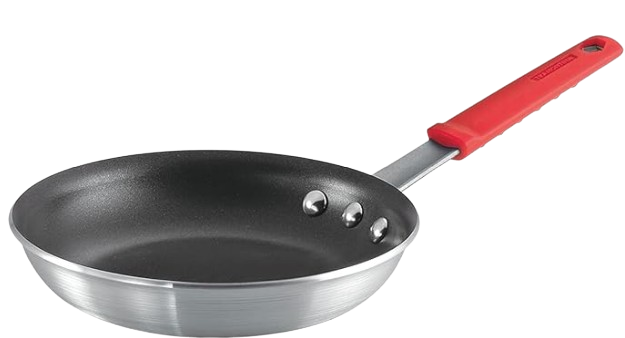
- Restaurant-grade build at a home-cook price
- Even heat distribution; zero hot spots in testing
- Removable silicone grip stays cool and oven-safe
- Consistently outperforms pans at 3× the price
- Lifetime warranty, NSF certified
- Not induction compatible
- Traditional PTFE coating, not PFAS-free ceramic
- Not visually exciting
The Tramontina Professional is the pan that food writers secretly reach for after testing $200 alternatives and going, “…yeah, the Tramontina is just better.” It’s NSF-certified (meaning it meets the standards for professional food service use), built from 3004-grade heavy-gauge aluminum, and the heat distribution is incredibly exceptional. It’s not induction-compatible and the PTFE coating means it’s not the choice if you’re trying to go completely PFAS-free; but for raw performance and value, nothing on this list touches it at this price.
PS: This is the non-stick frying pan that I’m still using…one year after and its still looking intact..
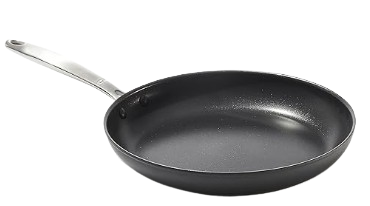
- America’s Test Kitchen and Cook’s Illustrated #1 pick
- PFAS-free ceramic coating; no PTFE at all
- Bowl-like shape is great for sauces, not just eggs
- Diamond reinforcement makes it tougher than standard ceramic
- Over 5,000 five-star Amazon reviews
- Not induction compatible
- Ceramic loses its slide faster than PTFE over time
- More expensive than Tramontina for different performance
America’s Test Kitchen called this their top pick, and it’s not hard to see why… The ceramic coating is diamond-reinforced, which gives it better durability than most ceramic pans, and the unusual bowl-like shape means you can actually make sauces and stews in it rather than just eggs and pancakes. It’s about $15–25 more than the Tramontina, and the trade-off is the PFAS-free coating if that’s important to you. Ceramic will still lose its nonstick properties faster than PTFE over time; that’s just the nature of the material, but proper care (low-medium heat, hand wash, no spray oil) extends it massively. A friend of mine purchased this 6 months ago from the writing of this article and it’s still going strong…
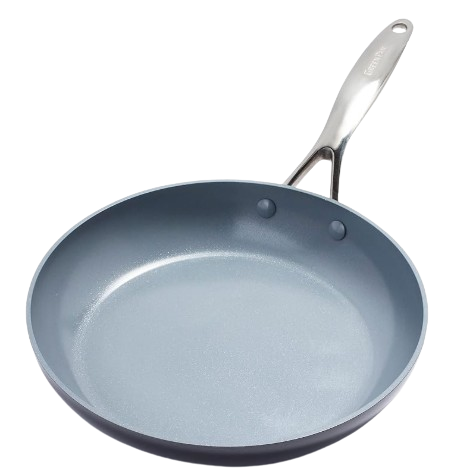
- Works on every stovetop including induction
- PFAS-free Thermolon ceramic coating
- Heavy base with excellent even heating
- Oven-safe up to 600°F
- Consistently recommended for induction households
- Handle is slightly chunky; not everyone loves the feel
- Ceramic degrades faster than PTFE over time
- More expensive than OXO for similar ceramic performance
The GreenPan Valencia Pro often shows up at the top of induction-friendly ceramic pan roundups, and it earned excellent scores in Consumer Reports’ cooking evenness test. The Thermolon coating is one of the more durable ceramic options available. It has a diamond-reinforced version that holds up better than plain ceramic. The 600°F oven-safe rating is unusually high for a nonstick pan. The handle is fine but not the most ergonomic, which is a minor gripe for a pan that otherwise delivers well.
If you’re looking for a quality non-stick frying pan ideal for an induction cooker, the The GreenPan Valencia Pro is your ultimate choice…
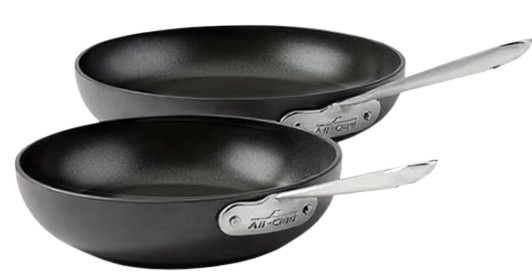
- Induction compatible; rare for high-quality PTFE nonstick
- Tri-layer coating lasts longer than single-layer pans
- Broiler safe up to 500°F; very versatile
- All-Clad build quality and strong customer support
- Great long-term investment for serious cooks
- Still PTFE; not ideal if avoiding traditional nonstick
- More expensive than budget options like Tramontina
- Handle comfort may not suit everyone
The All-Clad HA1 solves the problem a lot of induction users have: most really good nonstick PTFE pans don’t work on induction. The HA1 does. It also has a tri-layer coating, which means significantly better durability than a single-layer pan, and it’s broiler-safe to 500°F which opens up a whole category of stovetop-to-oven cooking. It’s expensive, but you can still get the Tramontina for a quarter of the price, however if you’re on induction and want traditional PTFE with longevity, this should be your only pick…
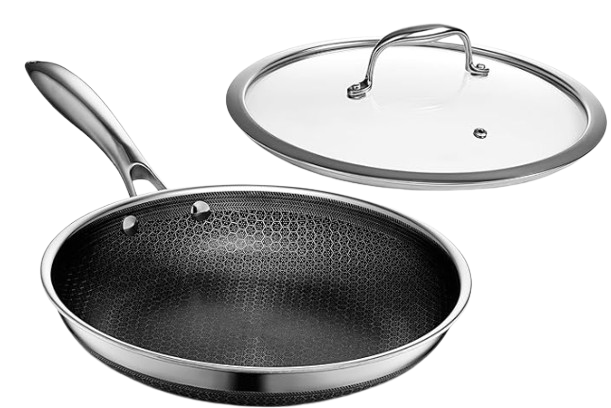
- Metal utensil safe; raised hex pattern protects coating
- Excellent searing ability (rare for nonstick-style pans)
- Faster heat conduction than many premium competitors
- Works on all cooktops including induction
- More durable than standard nonstick coatings
- Very expensive compared to traditional nonstick
- Not as slippery for eggs and delicate foods
- Past marketing claims have faced scrutiny
HexClad tends to be quite a polarizing pan…. The people who love it really love it…It has a hybrid construction giving you the searing capability of stainless steel with some nonstick protection in the recessed valleys of the hex pattern. Metal utensils won’t scratch it. It easily lasts substantially longer than the conventional nonstick. Those who aren’t big fans of it tend to approach it like a traditional nonstick pan, and it’s just not one. Delicate eggs can still stick. It’s only a hybrid, not a replacement for a dedicated nonstick pan. If you prefer metal this is your ideal frying pan…
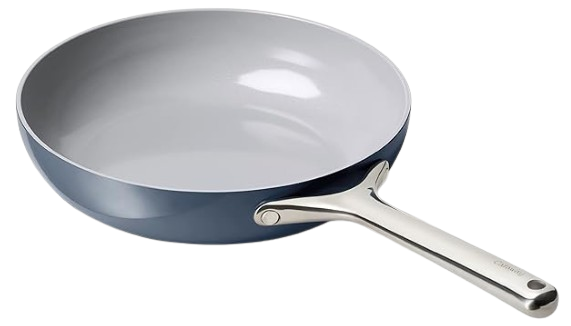
- PFAS-free; also free of lead and cadmium
- Oven-safe up to 550°F
- Works on induction cooktops
- Beautiful design with 10+ color options
- Well-reviewed in independent testing
- Hand-wash only to maintain coating lifespan
- Ceramic coating wears faster than PTFE (1–3 years typical)
- More expensive than similar-performing ceramic pans
- “Eco-friendly” claims can be somewhat overstated
The Caraway may be an Instagram brand but it is actually a quality product…It’s one of the only ceramic nonstick pans that’s explicitly PFAS-free, lead-free, and cadmium-free. Something to note is that it will lose its coating over time, probably 1–3 years with daily use, and the hand-wash requirement is also non-negotiable if you want it to last. If that probably sounds like too much work, the OXO or Tramontina may serve you better…
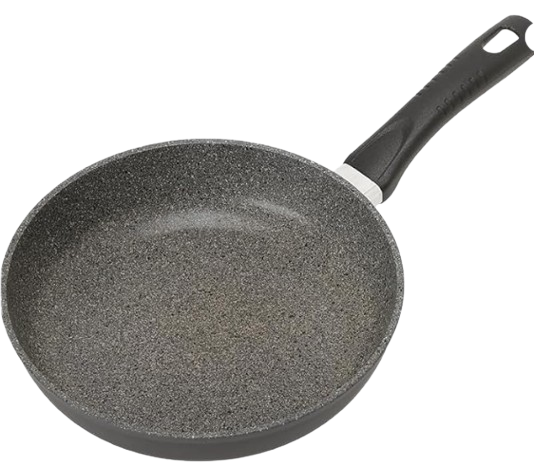
- Rivet-free interior; extremely easy to clean
- Thermopoint indicator shows ideal cooking temperature
- Durable 7-layer Granitium coating
- Made in Italy with Henckels quality standards
- Speckled finish hides wear over time
- Most versions are not induction compatible
- Lower oven-safe temperature due to soft-touch handle
- Less widely available than mainstream brands
Ballarini doesn’t get nearly the attention it deserves. ..The pan is made in Italy by a company backed by Henckels (who make excellent knives), the Granitium coating is a 7-layer affair that holds up better than standard nonstick, and the rivet-free interior is genuinely a quality-of-life upgrade; no more food getting stuck in those little ridges around the handle rivets. The Thermopoint indicator is also a nice touch too: it changes color to tell you when the pan is hot enough to cook on, and when it’s cool enough to safely clean. Some people find it quite gimmicky; I think it’s actually useful for nonstick pans where you shouldn’t be cooking on high heat anyway…Its quite affordable and its the best choice for a cheaper and quality non-stick frying pan..
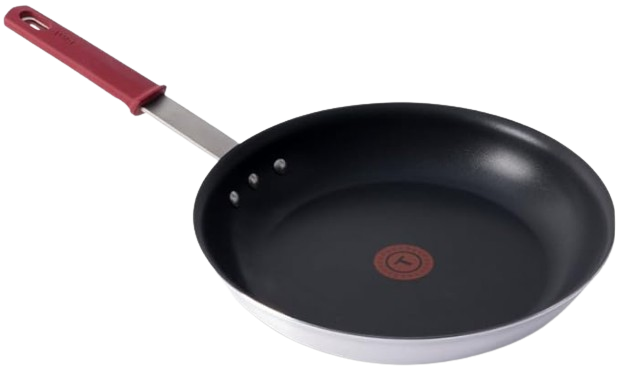
- Thermo-Spot shows exactly when the pan is preheated
- Very slippery surface; great for beginners
- Affordable and easy to replace over time
- Good heat distribution for the price
- Popular budget pick among everyday users
- Traditional PTFE; not PFAS-free
- Thinner build than premium options
- Not induction-compatible
The T-fal Professional shows up in Reddit nonstick conversations constantly, and for good reason…it’s quite affordable, the Thermo-Spot heat indicator is incredibly useful for beginners who aren’t sure when to start cooking, and it’s reliably non-stick out of the box. It’s slightly thinner than the Tramontina Professional, which means it’s a touch more prone to warping over time if you use high heat, but at this price point the expectation isn’t that it’ll last a decade. It’s a solid every-few-years pan you don’t stress about….
How to Actually Make Your Pan Last (Nobody Talks About This Enough)
Your non-stick pans don’t keep on dying, you’re not just taking care of them enough…Here’s how you make your non-frying pan last longer…
Never use cooking spray
Aerosol sprays build up sticky residue on nonstick surfaces that’s nearly impossible to remove and over time actually makes the pan stickier. Use butter or regular oil instead, always.
Low-to-medium heat only
Nonstick coatings degrade with high heat. You don’t need high heat for eggs, fish, or pancakes medium-low is plenty. Searing steaks? Use cast iron or stainless. That’s what they’re for.
Hand wash even when it says dishwasher-safe
Dishwasher heat and detergents gradually strip nonstick coatings. Manufacturers say dishwasher-safe because it’s legally defensible, not because it extends pan life. A 30-second warm rinse and soft sponge is all it takes.
Never heat it empty
Heating a nonstick pan empty is how coatings break down fastest. Add fat before heating, or heat on low first. Also genuinely dangerous to pet birds, take that seriously.
Silicone or wood utensils only
Metal spatulas physically scrape the coating. Even “metal utensil safe” pans experience accelerated wear with metal tools. Silicone spatulas are $5 and will double your pan’s lifespan.
Replace it when it starts sticking
There’s no fixing a damaged nonstick coating. When food starts sticking consistently or you see physical damage, buy a new one. There’s no shame in it, especially if it’s a $30 pan.
Okay, Here’s the Non-stick Frying Pan I’d recommend to a friend
If you’ve read this far and still can’t decide, here’s where I’d land for three different situations…
Please note that: Prices on all of these fluctuate regularly, Check current pricing before you buy to make sure you’re not paying full list price…
PS: Its my first time ever writing on a blog. So I’m not really a techy person.. If you like this style, I’d truly appreciate your comment, and if you have any suggestions...let me know,
Affiliate Disclosure: This page contains affiliate links; if you buy through them, I may earn a small commission at no extra cost to you.
By Nicole Walker: